Guides
Semax Price Guide (2026): What Determines the Cost of High-Quality Research Peptides?
Discover what influences the price of high-quality Semax research peptides, from manufacturing and HPLC testing to Certificates of Analysis (COAs), storage, supplier transparency, and batch documentation. Learn how experienced buyers evaluate value beyond price alone.
FutureCell Research Team · 16 min read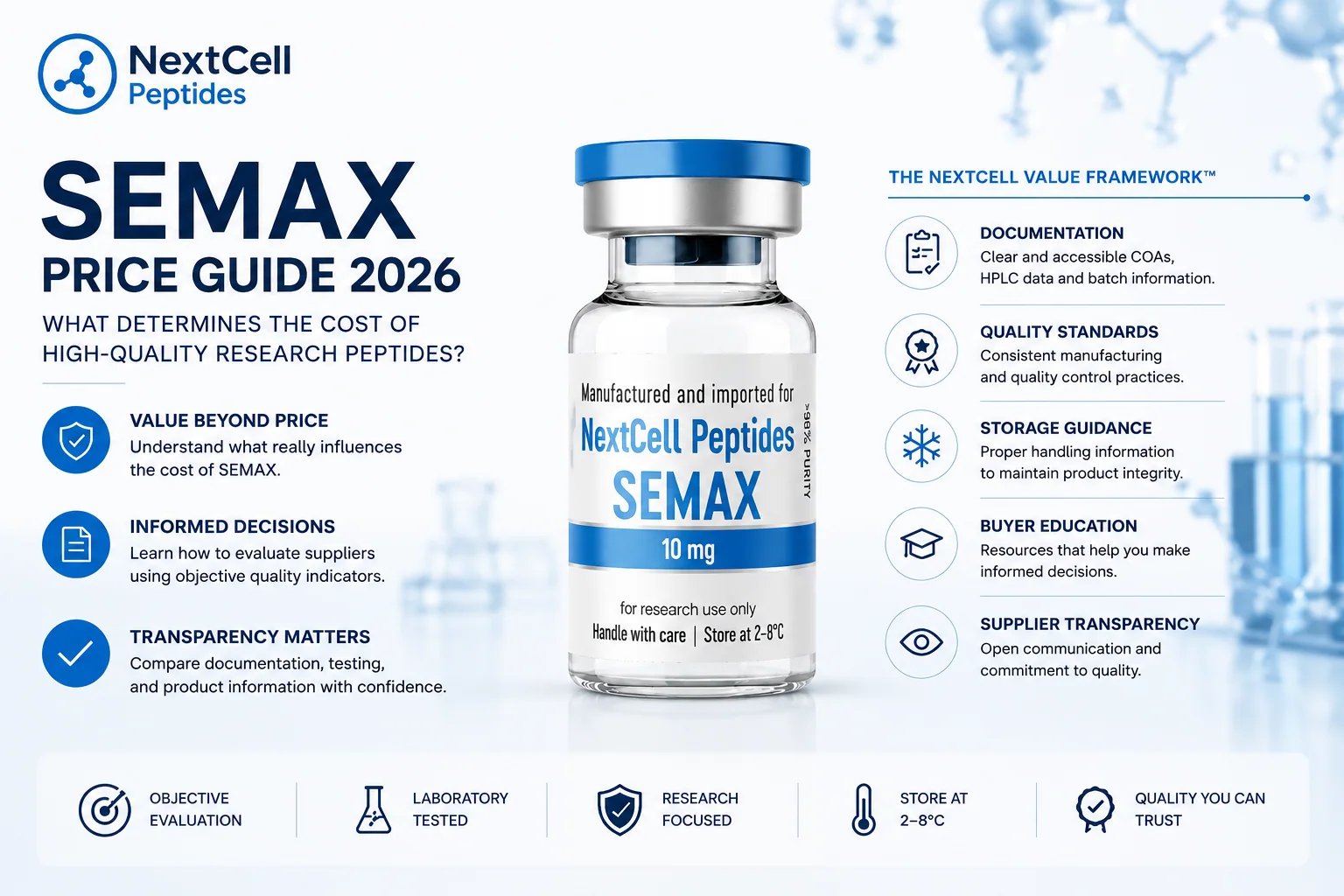
Introduction
The price of a research peptide often attracts immediate attention, but experienced researchers know that cost alone reveals very little about overall product quality. Two Semax products may appear nearly identical in packaging and advertised purity while differing significantly in manufacturing standards, analytical testing, documentation, and batch consistency.
Semax is a synthetic research peptide derived from a modified fragment of adrenocorticotropic hormone (ACTH). Producing consistent research-grade material requires controlled peptide synthesis, rigorous purification, comprehensive analytical testing, and documented quality assurance throughout manufacturing. Each of these factors contributes to the overall production cost and, ultimately, the market price.
For this reason, comparing suppliers based solely on price can be misleading. Lower prices may reflect larger production volumes or operational efficiencies, but they may also indicate reduced analytical testing, incomplete documentation, or inconsistent manufacturing controls. Likewise, a higher price does not automatically guarantee superior quality.
This guide explains the primary factors that influence the cost of Semax research peptides and provides a practical framework for evaluating whether a product offers genuine research value rather than simply a lower purchase price.
Readers seeking a broader overview of Semax can also review the Semax Research Peptide Buyer's Guide while those wishing to review the product specifications alongside this guide can visit the Semax Product Page.
Table of Contents
What Determines the Price of Semax?
Why Manufacturing Quality Influences Cost
The Role of HPLC Testing and Analytical Verification
Why Documentation Adds Value
Packaging, Storage and Product Presentation
Comparing Low-Cost vs Premium Semax
Buyer Evaluation Framework
Frequently Asked Questions
Related Research Guides
Summary
What Determines the Price of Semax?
The cost of a Semax research peptide is influenced by far more than the amount of peptide contained in a vial. Every stage of production—from peptide synthesis and purification to analytical testing, quality control, packaging, and documentation—contributes to the final price researchers see.
One of the largest cost factors is manufacturing consistency. Producing multiple batches that meet the same quality standards requires validated production processes, experienced personnel, and rigorous quality control. These investments increase production costs but also improve batch-to-batch reliability.
Analytical verification is another significant contributor. Independent testing methods such as High-Performance Liquid Chromatography (HPLC) require specialized laboratory equipment and trained analysts to verify the purity of each production batch. Suppliers that perform comprehensive analytical testing generally incur higher operating costs than those providing only limited documentation.
Documentation also plays an important role. Preparing batch-specific Certificates of Analysis (COAs), maintaining traceability records, and providing clear storage guidance all require additional quality assurance procedures. While these processes increase production costs, they also improve transparency and allow researchers to evaluate products using objective evidence rather than marketing claims.
Ultimately, the price of Semax reflects the combined cost of manufacturing, analytical verification, documentation, quality control, and supplier operations rather than the peptide alone.
Why Manufacturing Quality Influences Cost
Manufacturing quality is one of the most significant factors affecting the price of research peptides. Although two Semax products may appear similar, differences in production standards can influence consistency, documentation, and overall product quality.
Research-grade Semax is typically produced using solid-phase peptide synthesis (SPPS) before undergoing purification, analytical verification, and lyophilization. Each of these stages requires specialized equipment, controlled production environments, and qualified personnel to maintain consistent quality between batches.
Manufacturers that invest in robust quality management systems often perform multiple verification steps before releasing a batch. These procedures may include additional analytical testing, documentation reviews, and quality control checks that increase production costs but also support greater transparency and consistency.
For researchers, the lowest-priced product is not always the best value. Understanding how manufacturing standards contribute to overall quality allows buyers to compare products using objective criteria rather than price alone.
The Role of HPLC Testing and Analytical Verification
Analytical testing represents an important part of the overall cost of producing research-grade Semax. While manufacturing creates the peptide, analytical verification helps confirm that the finished product meets predefined quality specifications before it is released.
Among the most widely used analytical techniques is High-Performance Liquid Chromatography (HPLC), which is used to evaluate peptide purity following the purification process. Performing batch-specific HPLC analysis requires specialized laboratory equipment, validated analytical methods, and experienced personnel, all of which contribute to production costs.
Some manufacturers also perform additional analytical procedures to verify peptide identity or support internal quality control. Although the specific testing strategy may differ between suppliers, comprehensive analytical verification generally requires greater investment than relying solely on basic manufacturing controls.
For researchers, analytical testing should be viewed as part of the overall quality assurance process rather than simply an additional specification. Suppliers that invest in transparent analytical verification provide buyers with greater confidence when comparing products from different manufacturers.
Why Documentation Adds Value
Documentation is often overlooked when comparing research peptide prices, yet it represents one of the clearest indicators of supplier transparency. Preparing, reviewing, and maintaining batch-specific records requires both time and quality management resources, making documentation an important contributor to overall production costs.
A comprehensive Certificate of Analysis (COA) provides researchers with documented information relating to a specific production batch, including analytical results, batch identification, and testing details where applicable. When this documentation is prepared for every production batch rather than reused across multiple batches, it demonstrates a stronger commitment to traceability and quality assurance.
In addition to analytical reports, reputable suppliers often provide storage recommendations, batch identification, and educational resources explaining how documentation should be interpreted. Although these materials increase operational costs, they also reduce uncertainty for researchers evaluating different suppliers.
Ultimately, documentation adds value because it allows purchasing decisions to be based on verifiable information rather than promotional claims alone.
Packaging, Storage and Product Presentation
Packaging and storage are sometimes viewed as minor details, but they also contribute to the overall cost of supplying research peptides. High-quality packaging helps protect lyophilized peptides during transportation and storage while supporting clear product identification and batch traceability.
Professional presentation includes accurately labelled vials, visible batch numbers, appropriate storage guidance, and packaging designed to minimise unnecessary environmental exposure. These measures may increase production and fulfilment costs, but they also improve product consistency and reduce the likelihood of handling errors.
Although premium packaging alone does not indicate a higher-quality peptide, it often reflects a supplier's broader commitment to quality control and documentation. When considered alongside manufacturing standards and analytical testing, packaging forms part of a complete quality evaluation rather than an isolated feature.
Comparing Low-Cost vs Premium Semax
Price alone should never be used as the primary indicator of quality when comparing research peptides. While a lower-priced Semax product may represent good value, it is equally possible that important elements such as analytical testing, documentation, or quality control have been reduced to achieve a lower production cost.
Similarly, a premium price does not automatically indicate superior quality. Researchers should look for objective evidence supporting the product rather than assuming that a higher price reflects better manufacturing standards.
When comparing Semax suppliers, consider questions such as:
Is batch-specific analytical documentation available?
Are Certificates of Analysis (COAs) provided for each production batch?
Does the supplier explain its manufacturing and quality control procedures?
Are HPLC reports available upon request?
Are storage recommendations and batch numbers clearly displayed?
Does the supplier invest in educational resources that explain product quality?
Evaluating these factors provides a more reliable basis for comparison than price alone and helps researchers identify products that offer genuine value rather than simply the lowest cost.
Buyer Evaluation Framework
Rather than asking, "Which Semax product is the cheapest?", experienced researchers often ask, "Which product provides the strongest overall quality profile for its price?"
The following framework can help guide that evaluation:
Manufacturing transparency
Batch-specific HPLC testing
Certificates of Analysis
Batch traceability
Clear storage recommendations
Professional product labeling
Supplier transparency
Educational documentation
Consistent quality control
Considering these factors together allows buyers to evaluate overall value rather than focusing on a single specification such as price or purity percentage.
Frequently Asked Questions
Why do Semax prices vary between suppliers?
Differences in manufacturing standards, analytical testing, documentation, quality control, and operational costs all contribute to variations in pricing.
Does a higher price guarantee better quality?
No. Price should always be considered alongside objective quality indicators such as HPLC testing, Certificates of Analysis, manufacturing standards, and supplier transparency.
What should be included with a high-quality Semax product?
Researchers should look for batch-specific analytical documentation, clear batch identification, storage guidance, and transparent quality information.
Is HPLC testing worth paying more for?
Comprehensive analytical testing requires specialised laboratory equipment and contributes to production costs. Many researchers consider documented HPLC analysis an important part of evaluating research-grade quality.
Why is documentation important?
Documentation allows researchers to verify analytical information rather than relying solely on marketing claims, helping support objective product comparisons.
Related Research Guides
Continue your research with these educational resources:
Summary
The price of Semax reflects much more than the peptide itself. Manufacturing standards, purification, analytical testing, documentation, packaging, and supplier transparency all contribute to the overall cost of producing a research-grade peptide.
Rather than searching for the lowest-priced product, researchers should evaluate the complete quality profile supporting each batch. Batch-specific Certificates of Analysis (COAs), HPLC testing, traceability, and transparent documentation provide a stronger basis for comparison than price alone.
Understanding how these factors influence cost allows buyers to make informed purchasing decisions based on documented quality rather than assumptions. Researchers wishing to continue their evaluation can explore the Semax Research Peptide Buyer's Guide or review the Semax Product Page for product specifications and supporting documentation.