
Research
Research Peptide Batch Testing Explained
Research peptide batch testing helps verify identity, purity, and documentation. Learn what HPLC, MS, and Certificate of Analysis can show before purchase.
FutureCell Research Team · 6 min read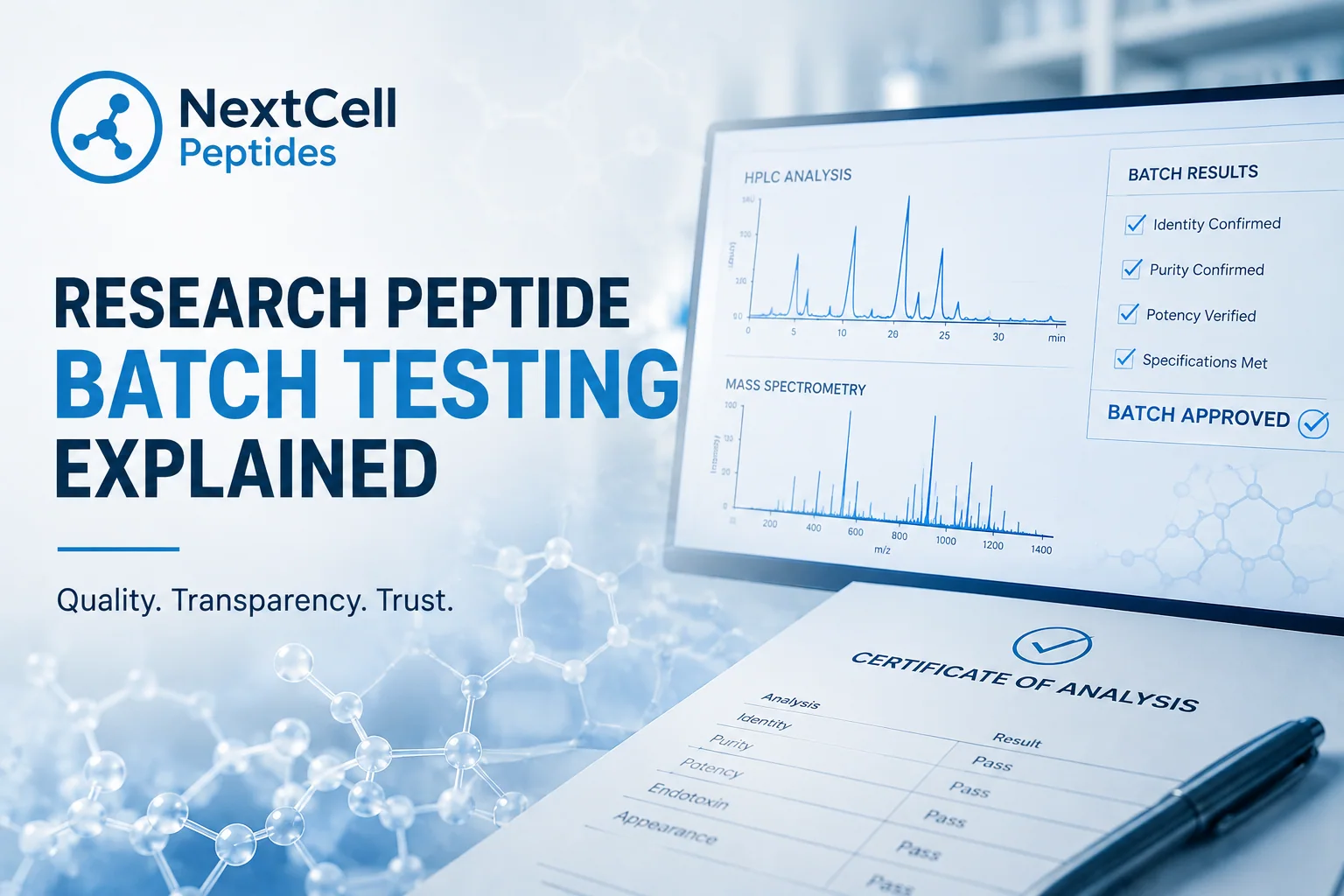
A vial label can state a peptide name and a high purity percentage, but those details mean far more when they are tied to a specific production lot. Research peptide batch testing is the process of examining that lot with defined analytical methods and documenting the results. For buyers comparing research peptides online, it is one of the clearest ways to assess whether a product is supported by evidence rather than broad marketing language.
Batch testing is not a single universal test. A useful quality package may combine chromatographic analysis, mass confirmation, and additional measurements selected for the product and its intended research context. The value lies in the connection between the physical material, the test method, the stated result, and the Certificate of Analysis, or COA.
What Batch Testing Actually Establishes
A batch, sometimes called a lot, is a defined quantity of material produced under the same controlled process. Testing a retained or representative sample from that batch allows a supplier to report results that apply to an identifiable lot number rather than to a peptide in general.
This distinction matters. A statement such as “99% purity” is incomplete if it does not identify the method used, the batch tested, and the date of analysis. A batch-specific result provides a more meaningful basis for comparing products, especially when researchers need consistency between repeat purchases.
In practical terms, research peptide batch testing is usually designed to answer three separate questions: Is the material the expected compound? How pure is the tested sample according to the analytical method? Does the supplied documentation clearly correspond to the product and lot received?
Those questions should not be collapsed into one. Identity confirmation does not automatically prove chromatographic purity. A high purity result does not, by itself, establish the exact quantity of peptide in a vial. Documentation is strongest when each claim is supported by an appropriate method and clearly reported result.
Core Methods in Research Peptide Batch Testing
HPLC Purity Analysis
High-performance liquid chromatography, commonly shortened to HPLC, is widely used to evaluate peptide purity. The technique separates components in a sample as they move through a chromatographic system. The resulting chromatogram shows peaks representing detected components, with the primary peak commonly associated with the target peptide.
A reported HPLC purity percentage generally reflects the relative area of the main peak under the stated test conditions. It is useful for identifying detectable peptide-related impurities and for comparing lots tested by the same method. However, HPLC results need context. Different columns, gradients, wavelengths, and integration settings can affect the chromatogram and the calculated value.
A credible COA should identify HPLC as the method and provide the result for the stated lot. When a chromatogram is available, it adds transparency by showing the separation profile behind the number. A purity percentage without a batch reference or method description provides less useful information.
Mass Spectrometry for Identity
Mass spectrometry, or MS, is commonly used to confirm molecular mass. For a peptide, the expected molecular mass is calculated from its amino acid sequence and relevant chemical form. The measured mass can then be compared with that expectation.
This is particularly valuable because peptide names alone are not sufficient proof of identity. MS supports confirmation that the tested material is consistent with the expected molecular structure. It can also help identify certain unexpected species, depending on the method and analysis performed.
Mass confirmation and HPLC work well together. MS addresses molecular mass, while HPLC provides a profile of chromatographic purity. Neither should be presented as a substitute for the other when both identity and purity are being claimed.
Additional Measurements When Relevant
The appropriate test panel depends on the product format and the scope of the supplier's quality controls. Lyophilized peptides, for example, may be evaluated for moisture content because excess moisture can affect material handling and storage characteristics. Residual solvent analysis may be relevant following synthesis and purification, while counterion information can be useful when interpreting total mass versus peptide content.
Other analytical work may include peptide content or assay testing, where applicable. These measurements are different from HPLC area purity. A sample can show a high main-peak percentage while its total peptide content is influenced by water, salts, counterions, or other non-peptide material. The exact testing needed depends on the research objective, not simply on the product category.
How to Read a Certificate of Analysis
A COA is most useful when it is specific, legible, and connected to the vial or packaging label. It should be treated as a technical record, not as a decorative certificate. Before purchasing or beginning research work, review whether the document includes the key details needed to trace the result.
A well-prepared COA typically includes:
The product name and, where relevant, peptide sequence or molecular information
A batch or lot number matching the supplied product
The test date and document issue date
The analytical method used, such as HPLC or MS
The reported result, units where applicable, and stated specification
The testing laboratory or responsible quality function
The most useful documents also make it clear whether testing was performed by the supplier, an independent third-party laboratory, or both. Independent testing can add confidence because it introduces a separate analytical review, although the scope still matters. A third-party report should identify what was tested, by which method, and for which lot.
Be cautious with generic COAs that lack a batch number, use a placeholder date, or appear to apply to every product regardless of lot. They may describe a historical example rather than the material currently available. A current, batch-specific COA is the stronger standard.
Questions to Ask Before You Buy
When comparing research peptide suppliers, the most productive questions are direct. Is the product lot identified on the label? Is a COA available for that lot? Does the COA state both a purity method and an identity method? Is the testing described clearly enough to understand what the result means?
It is also worth checking whether the listed product specification matches the documentation. For example, if a listing states a purity threshold, the COA should report a result that can be compared with that threshold. If the product is described as lyophilized, the product presentation and documentation should be consistent with that description.
Do not assume every test is equally relevant to every project. A buyer comparing BPC-157, GHK-Cu, TB-500, Semax, or other research compounds may need different documentation depending on the analytical purpose of the work. The core expectation remains the same: traceable identity, transparent purity reporting, and clear lot-level records.
Why Batch-Specific Documentation Matters
Peptide synthesis involves multiple stages, including assembly, cleavage, purification, and lyophilization. Even with controlled processes, each production lot should be viewed as its own defined material. Batch-specific testing acknowledges that quality is demonstrated lot by lot, rather than assumed from a product name or a prior production run.
This approach also supports better recordkeeping. If a researcher returns to a product at a later date, the lot number and COA make it easier to identify what was used. For repeat orders, documentation allows buyers to compare stated results across lots instead of relying on a single generic claim.
There is a practical trade-off. More complete testing and independent verification add time and cost to a quality program. Yet for research buyers, the alternative is often less clarity about the material being evaluated. Transparent documentation makes comparison more efficient because it gives customers technical information before they commit to a purchase.
Choosing a Documented European Supplier
For private customers buying research peptides online, supplier selection should extend beyond catalog size and price. Look for professionally labeled products, accessible batch documentation, clear specifications, and a stated approach to analytical verification. Reliable fulfillment also matters, particularly when ordering within the EU and expecting straightforward delivery and product traceability.
FutureCell Peptides supports its research product range with professionally labeled batches, Certificates of Analysis, and independent third-party testing where applicable, alongside EU-based fulfillment from the Netherlands. For buyers, that combination helps connect a simple purchasing process with the quality information needed to compare research materials responsibly.
The most useful habit is simple: read the lot number before you read the headline purity claim. A named peptide may be the starting point of a research purchase, but the batch record is where product integrity becomes measurable.