Research
Peptide Identity Versus Purity Explained
Peptide identity versus purity: learn what each test confirms, why both matter, and how to read a research peptide COA with greater confidence when buying
FutureCell Research Team · 7 min read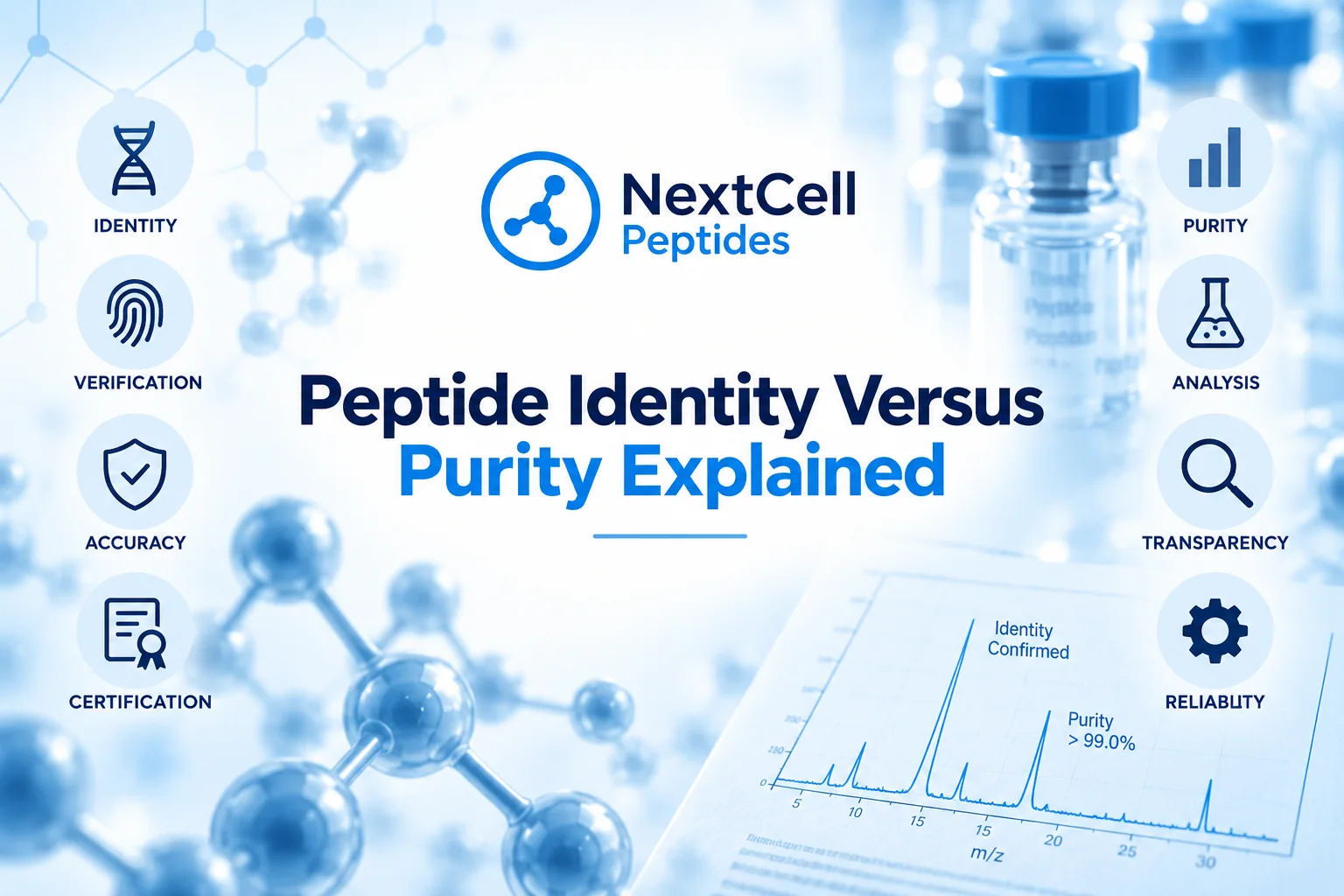
A reported purity percentage can look decisive on a product page, but it answers only one part of the quality question. Peptide identity versus purity is a distinction every research buyer should understand: purity asks how much of a sample is made up of its main detected component, while identity asks whether that component is actually the peptide specified on the label.
For research peptides, neither result is sufficient in isolation. A highly pure material that is not the intended sequence is unsuitable for the stated research purpose. Likewise, a correctly identified peptide with substantial related impurities, residual materials, or degradation products may introduce unnecessary uncertainty. Quality assessment begins when those two questions are considered together.
Peptide identity versus purity: two different claims
Identity is the confirmation that a product corresponds to the stated molecular entity. For a peptide, this usually concerns its molecular mass, amino acid sequence or composition, and expected chemical form. A vial labeled as BPC-157, GHK-Cu, TB-500, or another research compound should be supported by analytical evidence that aligns with the material named on its label and batch documentation.
Purity measures the proportion of the sample attributed to the target peak or principal component under a defined analytical method. High-performance liquid chromatography, commonly shortened to HPLC, is widely used for this purpose. The result is often displayed as an area percentage, such as 98% purity, based on the chromatogram generated under that method's conditions.
The difference matters because an HPLC trace does not automatically prove complete identity. It shows how components in a sample separate and how much detector response is assigned to each peak. A single dominant peak is useful evidence of cleanliness, but it is not, by itself, a complete confirmation of peptide sequence.
Identity asks: “Is it the right material?”
For peptide products, mass spectrometry is frequently used as an identity-supporting technique. It measures mass-to-charge behavior and can help verify that the observed molecular mass is consistent with the expected peptide. This is particularly valuable alongside a documented synthesis process and batch-specific testing.
However, analytical interpretation has limits. Some closely related structures can have the same or nearly identical mass. Isomeric amino acids, sequence-related by-products, salt forms, and modifications may require additional characterization depending on the material and the level of certainty required. Methods such as LC-MS, peptide mapping, amino acid analysis, or more specialized structural approaches may be used in advanced quality workflows.
For a private research buyer, the practical point is straightforward: look for identity evidence appropriate to the product rather than assuming a purity figure confirms everything.
Purity asks: “How clean is the sample?”
HPLC purity testing is valuable because peptide synthesis can generate related substances. These may include incomplete sequences, deletion peptides, truncated material, oxidation products, aggregation-related components, or remnants associated with the manufacturing process. A chromatogram helps reveal whether the target component dominates the measured sample.
That said, a purity number should always be read in context. The analytical column, mobile phase, detection wavelength, integration settings, and sample preparation can affect the reported result. A stated percentage is meaningful when it is paired with a clear method, a batch reference, and documentation that identifies the tested material.
Purity is also not the same as total peptide content. A lyophilized vial can contain water, counterions, salts, or other non-peptide components that are not always reflected in a simple HPLC area percentage. This is one reason a product's labeled quantity, net content, salt form, and purity value should be treated as related but separate specifications.
Why a high purity number alone can mislead
A high number is attractive, and it should be. But “99% purity” without context leaves several questions open. Was the tested sample taken from the same batch now being sold? Was the principal peak connected to the intended peptide by identity testing? Is the figure based on an HPLC area percentage or a different calculation? Does the Certificate of Analysis identify the method and the analyst or laboratory?
Consider two hypothetical batches. The first has a clean chromatogram with one dominant peak but lacks mass confirmation and batch traceability. The second includes an HPLC chromatogram, LC-MS data consistent with the stated molecular mass, a lot number, test date, and a batch-specific Certificate of Analysis. Both may display a similar purity percentage, but the second provides a far stronger basis for evaluating product integrity.
This is not an argument that every research purchase requires the same depth of analytical package. The appropriate level depends on the compound, the research setting, and the buyer's own documentation standards. It is an argument for avoiding a one-number view of quality.
How to read a peptide COA with confidence
A Certificate of Analysis should connect the product in hand to the data being presented. Start by checking that the product name, batch or lot number, and reported quantity match the item being evaluated. A generic certificate that cannot be tied to a specific batch has limited value for batch-level decision-making.
Next, review the identity section. This may reference LC-MS, MALDI-TOF, or another method and should report an observed value that is consistent with the expected molecular mass. For conjugated or metal-bound products, such as GHK-Cu, the stated form and analytical interpretation deserve particular attention because composition can be more complex than a simple unmodified peptide.
Then examine the purity result. A well-presented COA typically states the HPLC method or method type, gives a reported result, and may include the chromatogram. The chromatogram should show a clear major peak, but readers should avoid treating its visual appearance as a substitute for method details. Peak shape, retention time, and minor signals must be interpreted under the specific analytical conditions used.
Finally, look for practical documentation signals: the date of analysis, laboratory details, authorized review, and consistency between the certificate and product label. Independent third-party testing can add useful separation between the supplier and the analytical result, particularly when it is batch-specific and clearly documented.
Identity, purity, and other quality specifications
Identity and purity are central, but they do not represent the entire quality profile. Depending on the product, relevant specifications can also include peptide content, water content, residual solvents, microbial limits, endotoxin testing, storage conditions, appearance, solubility observations, and counterion information. Not every test applies to every research product, and not every data point carries the same relevance.
This is where transparent product specifications help buyers compare like with like. A lyophilized peptide described only by name and vial size offers less usable information than one supported by a stated purity threshold, a testing approach, clear labeling, and a corresponding COA. The goal is not paperwork for its own sake. It is reducing uncertainty before a material enters a research workflow.
What to compare before purchasing research peptides
When evaluating research peptides online, compare the evidence behind the specification rather than only the headline percentage. A useful purchasing review considers whether the supplier provides batch-tested documentation, whether identity and purity are addressed separately, and whether the product form is clearly described.
It is also worth considering fulfillment and handling transparency. For EU customers, sourcing through a supplier with EU-based fulfillment can make the purchasing process more straightforward, while professional labeling and clear batch references make documentation easier to organize after delivery. These details do not replace analytical testing, but they support traceability around it.
FutureCell Peptides presents research products with quality-focused specifications, Certificates of Analysis, and independent laboratory verification where applicable. For buyers comparing products such as BPC-157, MOTS-c, Semax, Epitalon, or CJC-1295 with Ipamorelin, that documentation provides a more useful starting point than purity claims viewed alone.
A better standard for peptide evaluation
The most reliable question is not “What purity percentage does this peptide have?” It is “What evidence shows that this batch is the stated peptide, and how clean is that verified material under a defined method?”
When identity data, HPLC purity results, batch traceability, and a readable Certificate of Analysis align, a research buyer has a clearer basis for comparison. That kind of transparency keeps attention where it belongs: on selecting well-documented materials suitable for careful research work.