
Research
GHK-Cu Skin Peptide Research and Evidence
GHK-Cu skin peptide research spans cell, tissue, and early human studies. Review the evidence, limitations, and material quality criteria for research use.
FutureCell Research Team · 6 min read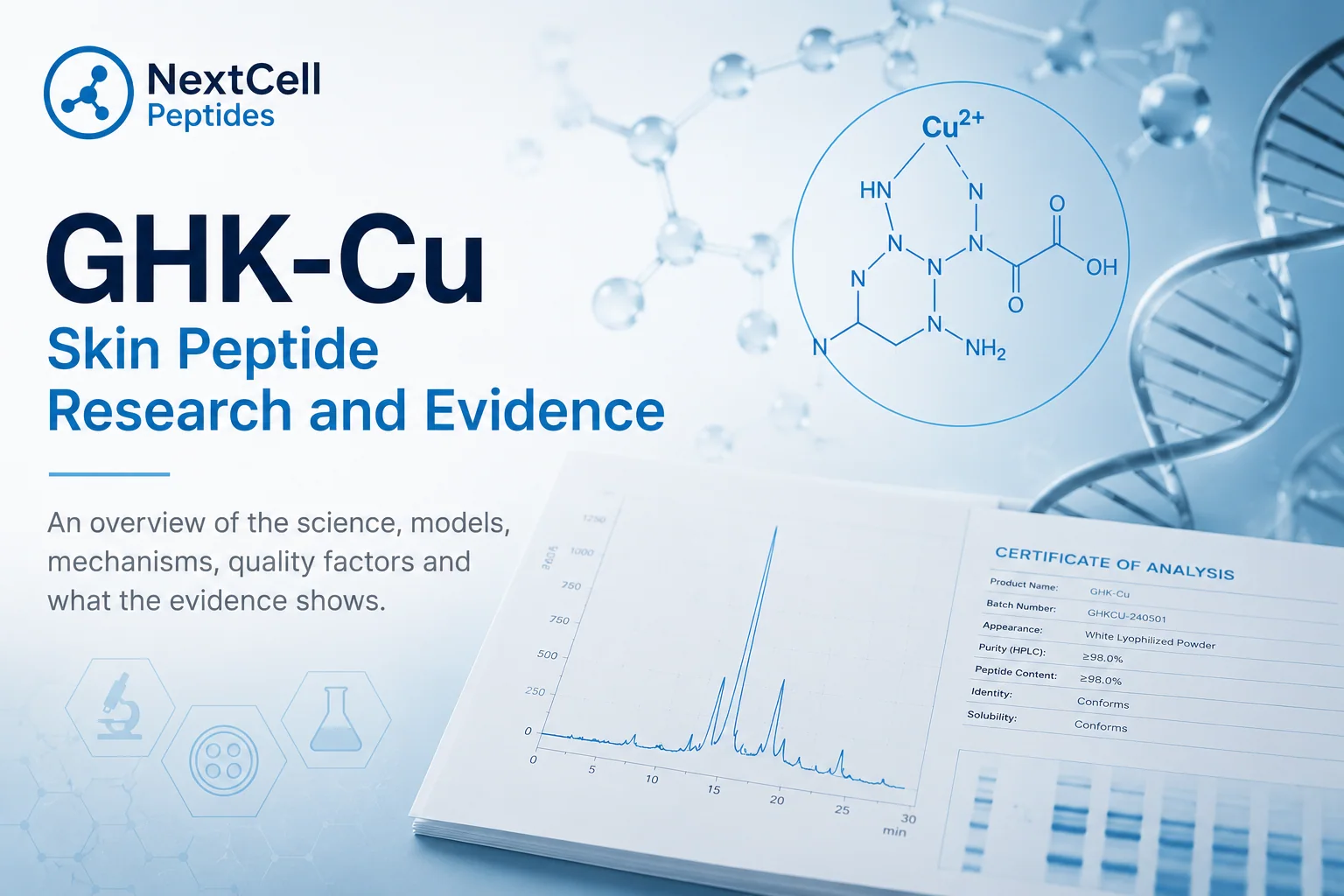
GHK-Cu is frequently discussed in skin-focused peptide literature because it combines a naturally occurring tripeptide sequence with copper, an element involved in numerous biological processes. But the interest surrounding the compound can obscure a basic question: what has actually been studied, in which models, and what can the available evidence support? GHK-Cu skin peptide research is broad enough to be interesting, yet uneven enough to require careful reading.
For research buyers, the value lies not only in knowing the peptide’s proposed mechanisms. It also lies in selecting material with clear identity, batch documentation, and analytical evidence that makes results more interpretable. Buyers evaluating GHK-Cu research products should therefore consider product specifications and supporting documentation alongside the published research. A promising study design cannot compensate for an uncertain starting material.
What Is GHK-Cu?
GHK-Cu refers to a copper complex formed with the tripeptide glycyl-L-histidyl-L-lysine, often written as GHK. The peptide was identified in human plasma and later examined in other biological contexts. When bound to copper(II), it forms the blue copper peptide commonly referred to as GHK-Cu.
Its compact structure has made it a recurring subject in biochemical, cell-culture, tissue, and cosmetic-science research. Researchers have investigated its interactions with extracellular matrix-related pathways, cellular signaling, gene-expression patterns, oxidative processes, and copper transport. These are mechanistic research areas, not a substitute for demonstrating a defined outcome in people.
A useful distinction is that GHK-Cu is not simply “copper plus a peptide.” Complex formation changes the compound’s chemical behavior and may influence how copper is presented within experimental systems. That is one reason researchers should identify whether a study concerns the GHK peptide alone, a defined copper complex, or a formulation containing multiple active ingredients.
What GHK-Cu Skin Peptide Research Examines
Much of the published interest centers on the skin’s extracellular matrix, the structural environment surrounding cells. In vitro research has explored whether GHK-Cu affects markers associated with collagen, elastin, glycosaminoglycans, and remodeling enzymes. These experiments can help generate mechanistic hypotheses, especially when they use controlled concentrations, defined cell types, and appropriate comparators.
Fibroblasts are commonly used in this work because they contribute to matrix production and maintenance. Several laboratory studies have reported changes in fibroblast activity or matrix-associated markers following exposure to copper peptide complexes. Such findings are relevant to early-stage research, but they should not be converted into broad claims about human skin outcomes. A cultured-cell model lacks the full complexity of intact skin, including barrier function, circulation, immune signaling, environmental exposure, and formulation effects.
Gene-expression research adds another layer. Some investigations have associated GHK-Cu with changes in transcripts related to tissue remodeling, inflammatory signaling, antioxidant responses, and cellular regulation. Gene-expression shifts can be valuable clues, but they are not direct proof that a pathway produces a meaningful or repeatable phenotype. The timing of measurement, cell model, analytical method, and data-processing approach all influence the result.
Why copper handling matters
Copper is biologically active, which makes experimental context especially important. It serves as a cofactor in several enzyme systems, yet free copper can also participate in unwanted redox activity under some conditions. The stability of the GHK-Cu complex, the presence of competing binding molecules, buffer composition, pH, and storage conditions may all affect the behavior observed in an assay.
This is one of the trade-offs in interpreting the literature. A study may show an interesting effect in a tightly controlled system, while a different system produces a smaller effect, no effect, or a result driven by formulation variables rather than the peptide itself. Good research does not treat variation as an inconvenience. It asks what caused it.
The Difference Between Preclinical and Human Evidence
The evidence base for GHK-Cu includes laboratory studies, animal research, ex vivo models, and a smaller body of human-facing cosmetic or dermatological research. These categories answer different questions and should not be grouped together as though they carry the same weight.
Cell and tissue models are useful for studying molecular interactions under controlled conditions. Animal work can provide information about a more complete biological system, although species differences limit direct translation. Ex vivo skin models may preserve certain structural features while still lacking the dynamics of living tissue. Human studies are most relevant to human outcomes, but their usefulness depends heavily on design quality, sample size, controls, endpoints, duration, and the composition of the tested formulation.
A recurring limitation is formulation complexity. Some human-facing studies assess products containing GHK-Cu alongside other peptides, antioxidants, moisturizers, or carrier systems. In those cases, it may not be possible to isolate the contribution of GHK-Cu. This does not make the research irrelevant. It means the conclusion must match the design.
For readers comparing research compounds, the practical standard is straightforward: separate mechanistic plausibility from demonstrated outcomes. GHK-Cu has a substantial rationale for continued investigation, but the strength of any claim should remain proportionate to the model and evidence behind it.
Quality Factors That Affect Research Interpretation
A label stating “GHK-Cu” does not, by itself, establish that a material is suitable for serious research. Identity, purity, quantity, and documentation all affect experimental confidence. This is particularly relevant for a copper peptide, where the intended complex, peptide integrity, and sample composition should be considered together.
High-performance liquid chromatography, or HPLC, is commonly used to assess chromatographic purity and identify the main peak associated with the expected material. A reported purity percentage can be helpful, but it should be read in context. HPLC does not automatically answer every question about identity, counterions, moisture, residual solvents, trace metals, or complex stoichiometry.
A Certificate of Analysis should clearly connect to the specific batch under consideration. At a minimum, researchers should look for the product name, batch or lot identifier, stated quantity, test methodology, result, date, and supplier details. Independent third-party testing can add another layer of confidence when it is available and appropriately documented.
Researchers should also assess whether the material is supplied as a lyophilized powder and whether the product specification states the expected peptide form. Packaging, storage information, and traceability may seem operational rather than scientific, but they matter. A poorly documented sample introduces uncertainty before an experiment begins.
Questions worth asking before comparing products
When reviewing GHK-Cu research material, start with a few connected questions. Is the copper complex explicitly identified? Does the Certificate of Analysis match the batch being purchased? Is HPLC data or a stated HPLC result available? Is the claimed quantity clear? Has testing been performed by an independent laboratory where applicable?
The answer is not always a simple purity threshold. A material with a headline purity figure but weak batch traceability can be less useful than one supported by clear, consistent documentation. Likewise, a well-documented product still needs to fit the researcher’s intended analytical or experimental context.
Building a More Useful Research Record
GHK-Cu studies become more comparable when researchers document details that are often omitted in informal discussions. The source and batch of the material, analytical documentation, model type, assay conditions, controls, time points, and method of analysis should be recorded from the outset. If a formulation or carrier is involved, that should be treated as an experimental variable rather than background detail.
Replication is equally important. Single experiments can identify signals worth pursuing, but repeated work across more than one system is more informative. Where possible, researchers can compare GHK-Cu with relevant controls, including the vehicle, peptide-only material, or copper-related comparators appropriate to the study question. The goal is not to force a positive result. It is to determine what the data can genuinely distinguish.
For private customers seeking research peptides online, this approach also improves purchasing decisions. A supplier should make it easy to compare product specifications and batch documentation without relying on exaggerated language. FutureCell Peptides supports this research-focused process with professionally labeled products, Certificates of Analysis, and quality documentation designed to help customers assess material before purchase.
Where the Research Is Most Promising
The most productive direction for future GHK-Cu work is not simply producing more positive-sounding findings. It is producing better-defined studies. That means validated material characterization, transparent reporting, relevant controls, reproducible endpoints, and a clear separation between observations in laboratory systems and outcomes that would require stronger human evidence.
GHK-Cu remains a compelling compound for skin-related research because the questions around it are specific enough to test: how does the complex behave in different models, which pathways are consistently affected, and which experimental conditions account for conflicting findings? For serious researchers, that uncertainty is not a drawback. It is the reason careful, well-documented work still has value.